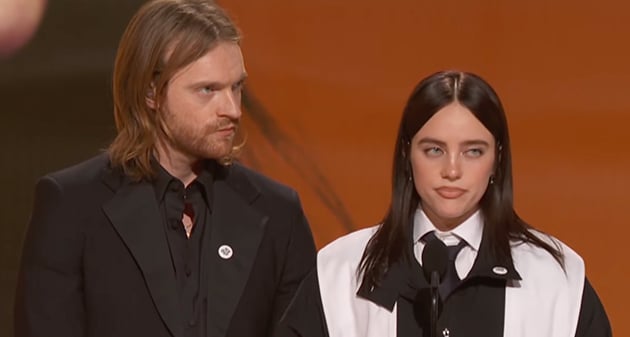
Billie Eilish’s remarks at the 68th Grammy Awards have ignited widespread discussion, touching on issues of immigration, colonial history, and celebrity responsibility. On February 1, the 24-year-old singer accepted Song of the Year for “Wildflower,” standing beside her brother and longtime collaborator, Finneas. In her acceptance speech, Eilish took a moment to address systemic issues, stating, “As grateful as I feel, I honestly don’t feel like I need to say anything but that no one is illegal on stolen land.” She followed with a blunt critique of U.S. immigration enforcement: “And f**k ICE, that’s all I’m gonna say, sorry!” Her comments, referencing centuries of European colonization in North America and the ongoing treatment of undocumented immigrants, were quickly circulated online, drawing praise from some quarters for their candor and criticism from others for perceived contradictions in her personal circumstances—particularly her ownership of a multimillion-dollar home in Los Angeles. The speech came at a time of heightened national debate on immigration policy, enforcement practices, and historical accountability, and Eilish’s choice to connect the issues to Indigenous history highlighted the complex intersections between activism, privilege, and personal responsibility.
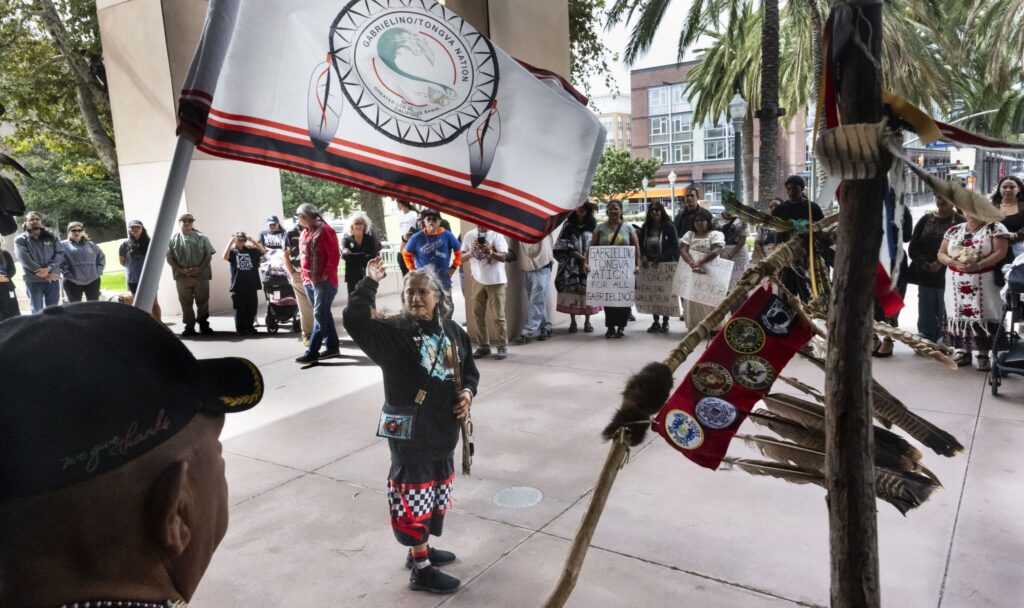
Los Angeles sits on the ancestral land of the Gabrieleno Tongva people, who have lived in the region for thousands of years. Following the public reaction to Eilish’s speech, a spokesperson for the Tongva tribe provided comments to The Daily Mail, emphasizing both historical context and the importance of accurate public acknowledgment. “We appreciate the opportunity to provide clarity regarding the recent comments made by Billie Eilish,” the spokesperson said. “As the First People of the greater Los Angeles basin, we do understand that her home is situated in our ancestral land.” While the singer had not reached out to the tribe directly regarding her property, the statement expressed appreciation for public figures who highlight Indigenous histories and perspectives. The tribe encouraged more precise references in future discussions, stressing that public recognition of the Gabrieleno Tongva as the original inhabitants of the Los Angeles basin is crucial for broader understanding. Reports indicate that representatives from the tribe reached out to Eilish’s team to convey their perspective, signaling a willingness for dialogue and collaboration while underscoring the importance of Indigenous voices in public conversations about land and colonization.
Eilish’s speech quickly became a flashpoint for debate across social media and political circles. Some users argued that if she believes in the concept of “stolen land,” she should take action regarding her Los Angeles property, such as returning it to the Tongva tribe or opening it to undocumented migrants. Political commentator Eric Daugherty suggested on X that she should “return her mansion” or “host illegal aliens” to align her lifestyle with her public statements. Conservative figures amplified similar arguments: Senator Mike Lee asserted that anyone acknowledging “stolen land” should “immediately give his or her land to Native Americans,” while Minnesota state Rep. Walter Hudson questioned why individuals invoking the phrase do not “donate everything and leave.” Florida Governor Ron DeSantis dismissed Eilish’s comments as “stolen land nonsense,” and Tesla CEO Elon Musk echoed related sentiments with a brief “Exactly.” Many critics adopted a sarcastic tone, emphasizing what they see as a disconnect between celebrity activism and personal wealth, framing the conversation as part of a broader cultural debate over authenticity, moral responsibility, and privilege in the age of social media.
The controversy also dovetails with long-standing debates over immigration enforcement in the United States. Eilish has previously criticized the U.S. Immigration and Customs Enforcement agency, commonly known as ICE, for what she describes as misconduct and heavy-handed tactics. Her Grammy remarks reinforced that position, connecting the historical displacement of Indigenous peoples to contemporary policies affecting undocumented immigrants. The comments emerged amid renewed scrutiny of ICE enforcement, including high-profile raids and arrests that have reignited national debates about federal immigration policy and the humanitarian consequences of enforcement operations. By linking colonization, contemporary migration, and state authority, Eilish highlighted systemic issues that extend far beyond individual experiences, positioning her speech as a critique not just of policy but of historical and structural power dynamics. Her remarks, therefore, were more than a personal political statement—they were an attempt to situate contemporary debates within a longer history of land dispossession, displacement, and inequity.
The episode underscores a recurring tension in American public discourse: how celebrities navigate advocacy while maintaining private property and wealth. Supporters praised Eilish for using a highly visible platform to spotlight systemic injustices tied to colonization and immigration, seeing her speech as an example of modern activism. Critics, however, argued that her ownership of a multimillion-dollar home in Los Angeles undermined the message, framing it as performative or inconsistent. The Tongva tribe’s measured response added nuance to the debate, recognizing the historical truth of Indigenous land claims while encouraging future public statements to more explicitly reference the tribe. The exchange demonstrates how public acknowledgment of historical and social issues requires both awareness of context and careful consideration of personal circumstances, especially when individuals occupy positions of significant wealth and influence. Celebrities are often expected to reconcile personal privilege with advocacy, and failure to address this expectation can overshadow the substance of their message, creating a tension between intent and perception.
Eilish’s Grammy comments illuminate larger questions about accountability, acknowledgment, and activism in contemporary culture. The conversation extends beyond celebrity critique, encompassing how society engages with the legacies of colonization, the ethical obligations of property ownership, and the treatment of immigrants and Indigenous communities. As the debate continues, it raises questions about what acknowledgment requires in practice, how public figures can advocate for systemic change while navigating private wealth, and how Indigenous communities wish to be represented in these conversations. While Eilish has not publicly elaborated on her Grammy remarks since the ceremony, the discussion highlights the ongoing tension between visibility, responsibility, and authenticity in modern public life. It also illustrates a broader challenge: balancing the need to recognize historical injustices with the practical realities of contemporary society, including private property, governance, and civic engagement. In this context, the conversation surrounding her speech is not simply about a celebrity moment—it is a reflection of enduring social debates over land, power, history, and the responsibilities of those with influence in shaping public understanding.