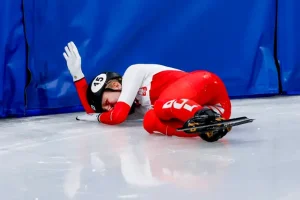
The roar inside the Milano Ice Skating Arena turned to collective horror on Friday night as an illegal maneuver in the women’s 1500-meter short-track speed skating quarterfinal nearly resulted in one of the most gruesome injuries of the 2026 Milan-Cortina Winter Olympics so far. What began as a tightly contested Olympic heat, with athletes racing mere centimeters apart at astonishing speeds, ended with blood on the ice, medics rushing onto the rink, and stunned silence from spectators who had only moments earlier been cheering at full voice. In a sport where the margin between victory and calamity is infinitesimal, chaos unfolded in seconds but left a lasting impression on everyone in attendance and those watching around the world. Poland’s 25-year-old Kamila Sellier, competing on the sport’s grandest stage, became the unwitting victim of a terrifying chain of events when a rival’s skate blade struck her face after a chaotic fall triggered by an illegal lane change. The incident underscored the razor-thin line between elite athletic performance and serious danger in short-track speed skating, one of the Winter Games’ fastest and most unforgiving disciplines, and instantly became a chilling reminder of the risks athletes willingly embrace in pursuit of Olympic glory.
The sequence that led to the accident began when Team USA’s Kristen Santos-Griswold attempted a lane change that officials later deemed illegal under the strict regulations governing short-track racing. As she shifted lanes, her right leg kicked outward uncontrollably, sending her off balance and into the tightly packed field of competitors skating at speeds exceeding 40 kilometers per hour. With fractions of a second to react, fellow skaters had almost no room to adjust, resulting in a domino effect that culminated in Sellier being struck in the face. The impact did not stop with the Polish athlete; Italy’s decorated veteran Arianna Fontana, a 14-time Olympic medallist, was also swept into the tumble, while Santos-Griswold herself collapsed onto the ice. Race officials quickly halted the heat as the severity of the situation became apparent, and while Santos-Griswold was subsequently penalized and disqualified from advancing to the semifinals, the competitive consequences rapidly became secondary to the urgent concern for Sellier’s welfare. The shocking speed at which elite athletes can go from precision to peril in short-track racing became horrifyingly apparent to all watching.
Slow-motion replays broadcast in the arena and circulated online revealed just how narrowly a true catastrophe had been avoided. The footage showed Santos-Griswold’s skate making direct contact with Sellier’s protective eyewear, knocking it cleanly off her face before the blade sliced into the flesh around her eye. Spectators and viewers alike recoiled as the camera captured the instantaneous moment of contact — a flash of steel followed by the crimson spreading across the ice. While athletes wear cut-resistant suits and gloves designed to mitigate injury, their faces remain largely exposed, protected only by eyewear that offers minimal shielding against the sport’s razor-sharp blades. These skates are precision-engineered to carve through ice with minimal resistance, allowing for extraordinary speed and maneuverability, but rendering even minor contact potentially dangerous. The near-miss highlighted the intrinsic hazards of short-track speed skating, where blades traveling at high velocity can turn competitive strategy into a matter of life-or-death consequences in the blink of an eye. Commentators struggled to maintain composure as medics sprinted onto the rink and teammates looked on in visible distress, capturing the collective shock felt by both the arena and the global audience.
In the immediate aftermath, a white privacy sheet was quickly unfurled around the fallen skaters as emergency personnel assessed injuries. Sellier lay on the ice with blood visibly flowing from the area surrounding her eye, staining the pristine surface beneath her. Despite the severity of the situation, she managed a small, courageous gesture — raising a thumb toward the crowd — which drew a wave of relieved applause and offered a fleeting sense of reassurance amid the chaos. She was carefully placed on a stretcher and carried off the ice, leaving a faint trail of blood behind her, while the arena remained eerily quiet in the wake of the incident. Around the world, social media exploded with expressions of disbelief and concern. One widely shared post on X described the crash as “straight-up terrifying,” noting the high-risk nature of a sport where “razor-sharp blades fly at 40+ km/h in tight packs.” Many observers emphasized the sheer luck involved, recognizing that Sellier’s survival and avoidance of permanent eye damage were nothing short of miraculous. The incident instantly became one of the defining, most sobering images of the Games, illustrating both the inherent dangers of short-track speed skating and the extraordinary bravery of its competitors.
Sellier was transported immediately to a Milan hospital, where she underwent emergency surgery late that evening. On Saturday morning, a spokesperson for Poland’s Olympic team confirmed that the procedure had been completed successfully and that the athlete was in stable condition. Surgeons repaired a deep cut on her cheek and treated lacerations to her eyelid, which had reportedly been partially sliced by the blade. Crucially, initial assessments suggested that the eye itself had avoided direct injury, though further testing was planned to determine whether any internal trauma or delayed complications had occurred. The Polish delegation expressed cautious optimism, acknowledging that swelling around the injury made it difficult to fully evaluate the extent of the damage. Relief spread quickly throughout the international speed skating community as news circulated that her vision appeared to remain intact, yet the emotional shock of witnessing such a near-tragic event lingered. Fellow athletes and coaches highlighted the harrowing reality that even the most highly trained competitors remain vulnerable to the unpredictable forces of speed, skill, and proximity that define short-track racing.
Polish speed skating chief Konrad Niedźwiedzki later provided additional context, explaining that medical professionals were also evaluating potential damage to Sellier’s zygomatic bone, commonly referred to as the cheekbone. Significant swelling complicated immediate diagnosis, leaving uncertainty regarding whether the force of the blade had caused a fracture or additional underlying trauma. “There is considerable swelling, so it’s hard to say at this point what else happened inside,” Niedźwiedzki told local media, urging patience as doctors completed imaging tests and monitored her recovery. For now, hope outweighed fear. Sellier remained under close observation, surrounded by supportive teammates and medical staff, her Olympic campaign abruptly interrupted but her long-term health appearing far more secure than many had feared. The incident has already sparked discussions within the sport regarding safety improvements, from reinforced facial protection to stricter enforcement of passing rules, emphasizing the delicate balance between competitive intensity and athlete welfare. Above all, it stands as a stark testament to both the peril and resilience woven into Olympic sport. In a Games meant to celebrate excellence and human achievement, this terrifying moment reminded the world how fragile those limits can be and how fortunate everyone was that the story did not end in permanent tragedy.