Dyan Cannon’s name carries with it decades of Hollywood history, a time when movie stars were not merely performers but also icons of glamour, aspiration, and cultural change. With her radiant smile, expressive eyes, and unmistakable charisma, Cannon became a familiar presence on screens both large and small, embodying a kind of effortless charm audiences associated with classic American cinema. To the public, her life often seemed like a carefully scripted narrative, filled with red carpets, prestigious awards, and celebrated roles. Yet beneath the polished surface lay a woman navigating the immense pressures of fame, personal expectation, and constant reinvention. Even decades after the height of her stardom, Cannon continues to captivate attention, reminding the world that a public figure’s legacy does not fade quietly; it evolves alongside time, adapting to new contexts and interpretations while maintaining a distinct resonance.
Her professional career stands as a testament to both talent and persistence. Spanning multiple decades, Cannon demonstrated remarkable versatility, moving fluidly between genres and proving herself far more than a single-type actress. She earned three Academy Award nominations, multiple Golden Globe nods, and a Saturn Award, achievements that cemented her status as one of the most respected performers of her era. In 1983, her contributions were permanently recognized with a star on the Hollywood Walk of Fame, an honor reserved for those whose impact endures beyond fleeting popularity. Films such as Bob & Carol & Ted & Alice, Heaven Can Wait, The Last of Sheila, and Deathtrap showcased her range, allowing her to blend humor, charm, and emotional depth with a natural sincerity. Her performances resonated because they reflected a woman who understood both vulnerability and strength, often within the same scene, crafting characters that felt authentic and compelling to audiences.
One of the most publicly discussed chapters of Cannon’s life was her marriage to Cary Grant, a union that captivated the media from the beginning. Their relationship seemed like a story drawn from Hollywood mythology: the legendary leading man paired with a rising star, bound together by romance and fame. Yet the reality behind the cameras proved far more complicated. Cannon has since spoken openly about the emotional toll of the marriage, describing a dynamic in which she felt increasingly controlled and diminished. Over time, she said, she lost touch with her own identity, shaped instead by expectations that did not align with her inner self. Though the marriage lasted only three years, its impact lingered, influencing her understanding of independence, self-worth, and the subtle cost of living under constant public scrutiny.
Despite the challenges associated with that period, Cannon has consistently expressed that her feelings toward Grant were genuine and devoid of bitterness. Their daughter, Jennifer, born in 1966, became a lasting connection between them beyond divorce and media narratives. Motherhood provided Cannon with a grounding force, a deeply personal aspect of life that existed outside the gaze of the public. In the decades that followed, she continued to work, write, and explore new creative outlets, refusing to allow a single relationship or chapter to define her entire story. Her resilience did not stem from denial of hardship but from acknowledging it fully and choosing to move forward with honesty, embracing both her achievements and her struggles as integral parts of her journey.
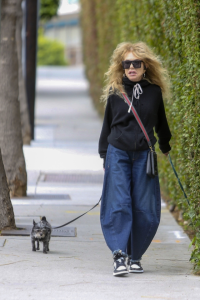
In recent years, Cannon has once again been the subject of public discussion, albeit for something as ordinary as walking her dogs. Photographs of her in her late eighties, dressed casually and moving at her own pace, sparked a wave of reactions online—some celebratory, some critical. Admirers praised her vitality, independence, and enduring spirit, while others reflected cultural discomfort with aging women, particularly those who had long symbolized youthful glamour. The intensity of these reactions revealed more about societal expectations than about Cannon herself. Her walk, a simple act of daily life, became a mirror reflecting unresolved attitudes toward beauty, age, and the ongoing relevance of women in the public eye, highlighting how deeply entrenched notions of time and image remain in collective consciousness.
Now in her late eighties, Dyan Cannon speaks of her life with a sense of peace that feels earned rather than accidental. She credits faith and spiritual reflection for bringing her to a place of genuine happiness, one that no longer relies on applause or external validation. Having lived through fame, heartbreak, reinvention, and scrutiny, she describes herself with disarming simplicity as “a happy puppy now.” In that phrase lies a quiet triumph: a woman who has moved beyond the roles imposed on her by Hollywood and society, choosing instead to define herself on her own terms. Her story continues not as a cautionary tale or nostalgic memory, but as a living testament to endurance, self-discovery, and the freedom that comes with age when one stops performing for the world and begins performing for oneself.