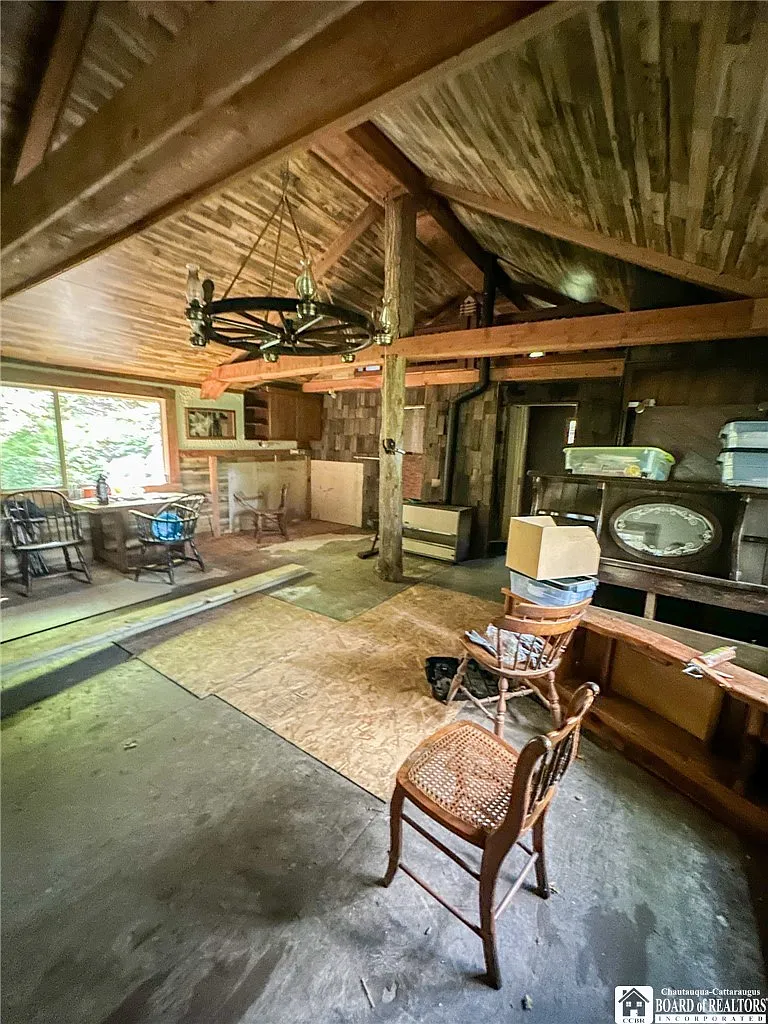
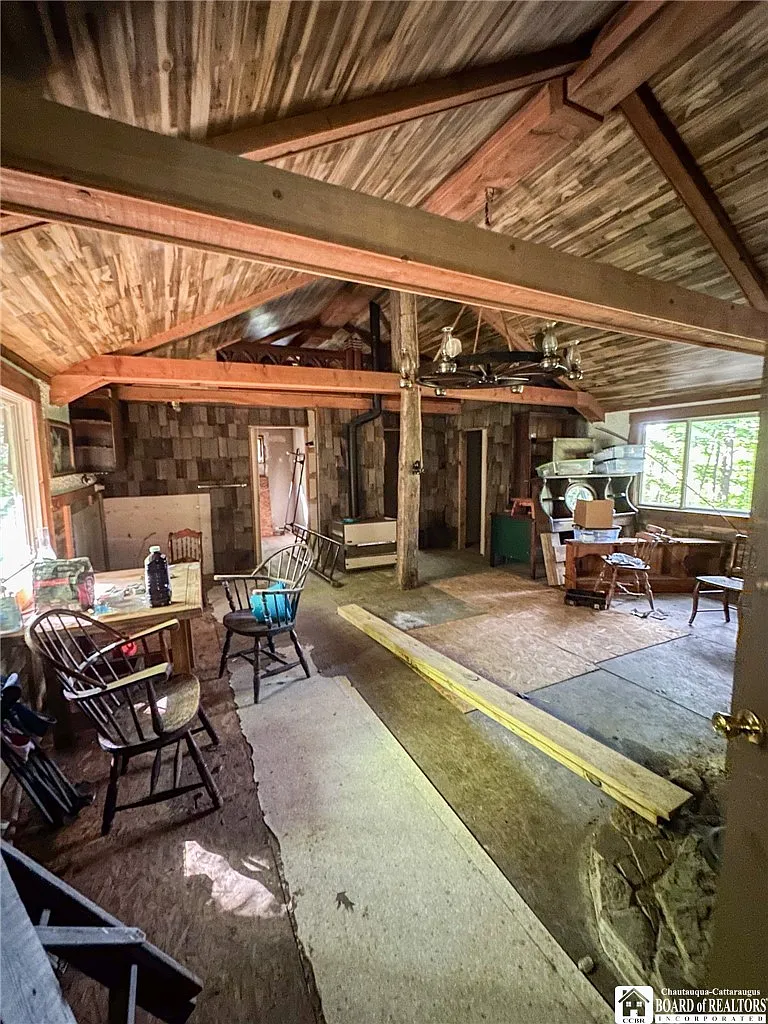
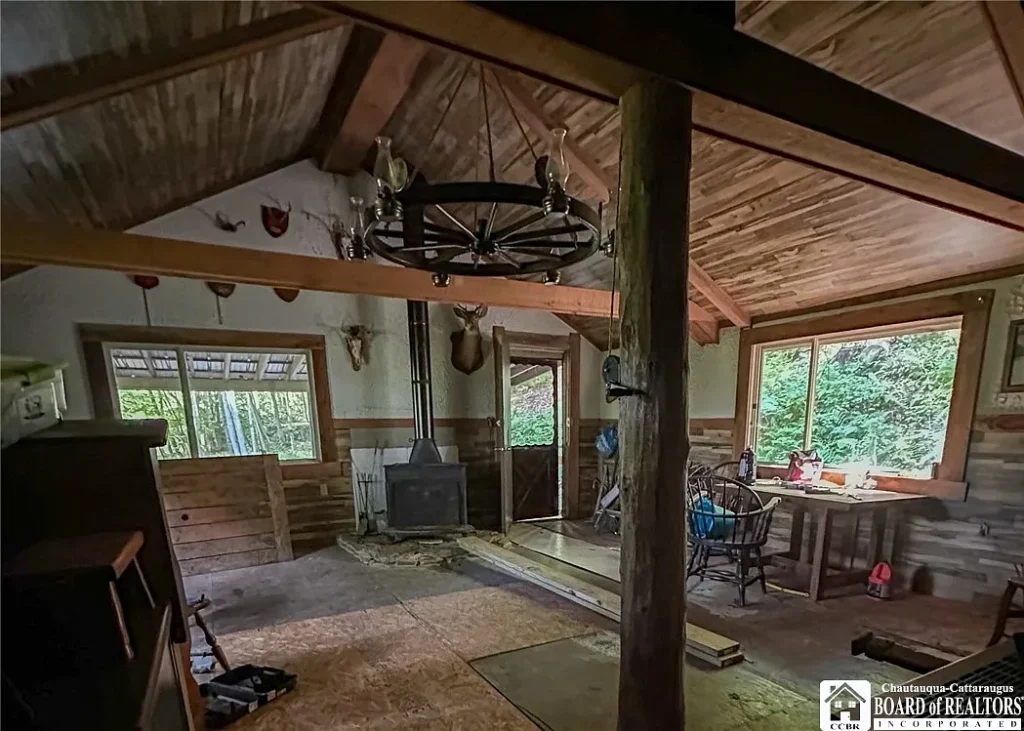
Hidden deep in the quiet woods near Rock City Park, this three-bedroom cottage sits like a paused idea rather than a finished home. It is not presented as something complete or polished, but as something intentionally stripped back to its bones—an architectural blankness that feels more like possibility than absence. The structure has been fully gutted, leaving behind the essential frame and shell: walls without their interior identity, floors reduced to their supporting logic, and rooms that no longer insist on how they should be used. What remains is not comfort in the traditional sense, but potential—a kind of raw openness that asks the next owner not just to live in it, but to decide what it becomes. In that way, the property resists the usual language of real estate and leans closer to something creative, almost participatory. It is less “this is what it is” and more “this is what it could be,” which is both its challenge and its appeal.
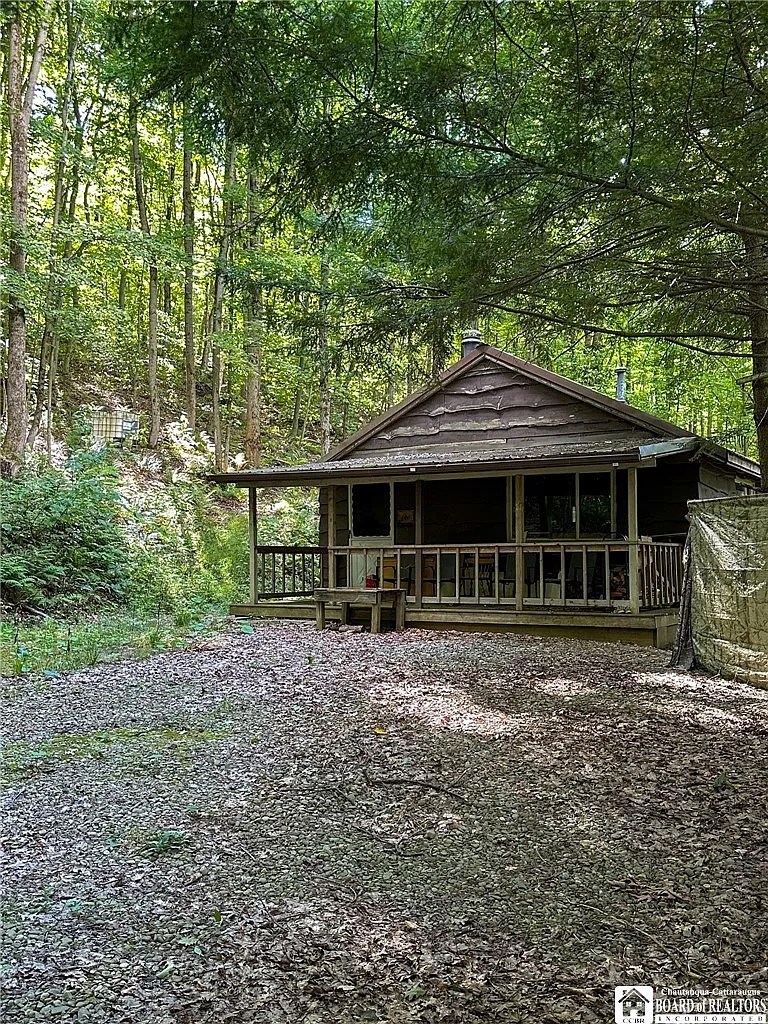
Set on approximately 1.3 acres in Allegany, the land around the cottage plays an equal role in defining its character. The wooded surroundings do not simply frame the property; they absorb it. Tall trees create a natural enclosure that filters light into shifting patterns throughout the day, while the density of the forest offers a sense of seclusion that is increasingly rare in more developed areas. This is not an open, manicured landscape designed for visibility, but a textured environment where privacy emerges naturally from geography rather than fences or walls. For someone seeking distance from urban pace, the setting provides a kind of quiet that is not empty, but layered—filled with wind movement, bird activity, and seasonal change that becomes more noticeable the longer one stays still. In this context, the cottage does not sit apart from nature so much as within it, as if it were temporarily resting there until it is shaped into its next form. The sense of retreat is not abstract; it is built into the land itself, which encourages slower rhythms and more deliberate attention to detail.
The existing structure offers several elements that hint at its original life while also supporting future transformation. A covered front porch extends outward like a transitional space between interior and forest, a place where boundaries soften and the outside becomes part of daily routine. It suggests use not as a decorative feature, but as a functional pause point—somewhere to sit, observe, and exist without urgency. Inside, a wood stove remains in place, providing both a practical heating option and a symbolic anchor of older, simpler building traditions. It speaks to a kind of self-reliance that aligns naturally with the property’s rural character, where utility and atmosphere often overlap. Even in its stripped-down state, the cottage still carries traces of intention, as if its previous version had already begun shaping it toward a certain kind of life—one oriented around warmth, manual upkeep, and seasonal awareness. These remnants do not define what the home must become, but they offer continuity between what it was and what it might be.
From a practical standpoint, some foundational improvements have already been completed to support future renovation work. Exterior French drains have been installed to manage water flow and improve long-term structural stability, an important consideration in wooded environments where moisture and runoff can become persistent challenges. Certain floor supports have also been reinforced, suggesting that while the interior has been cleared, attention has been paid to preserving the integrity of the structure itself. These are not cosmetic upgrades but infrastructural ones, the kind that matter most when rebuilding from an unfinished state. An existing outhouse further emphasizes the property’s readiness for more self-sufficient or off-grid living arrangements, depending on how the next owner chooses to develop it. Taken together, these elements create a foundation that is not complete, but functional enough to build upon without starting entirely from zero. It is a halfway point between abandonment and intention, where the hardest structural uncertainties have already been addressed.
What distinguishes this property most clearly is not what it offers in its current condition, but what it deliberately leaves unresolved. It is not a move-in-ready home, and it does not pretend to be one. Instead, it presents itself as a kind of architectural permission: the freedom to design without having to undo someone else’s finished decisions first. That openness can be intimidating to some and liberating to others. For a buyer with vision, it becomes an invitation to participate directly in shaping space, rather than adapting to an existing layout. It could become a rugged hunting camp, designed for seasonal use and practical resilience. It could evolve into a quiet woodland retreat, focused on simplicity and retreat from overstimulation. Or it could be rebuilt into something more personalized and unconventional, shaped entirely by individual preference rather than predefined categories. The absence of completion is what allows for this range of outcomes. In a sense, the property does not limit possibilities; it delays them until someone chooses a direction.
In the end, this cottage near Rock City Park is defined less by what it currently is and more by the rare condition it offers: a physical structure paired with creative freedom. The surrounding forest provides privacy without effort, the existing frame provides stability without completion, and the unfinished interior provides space for imagination without constraint. Properties like this occupy a narrow space in the real estate landscape, where value is not measured by immediate livability but by potential transformation. It is a place that asks for participation rather than passive occupancy, and for someone willing to take on that role, it becomes more than just a house. It becomes a project, a retreat, and a personal interpretation of what living in nature can mean when stripped of excess and rebuilt with intention.